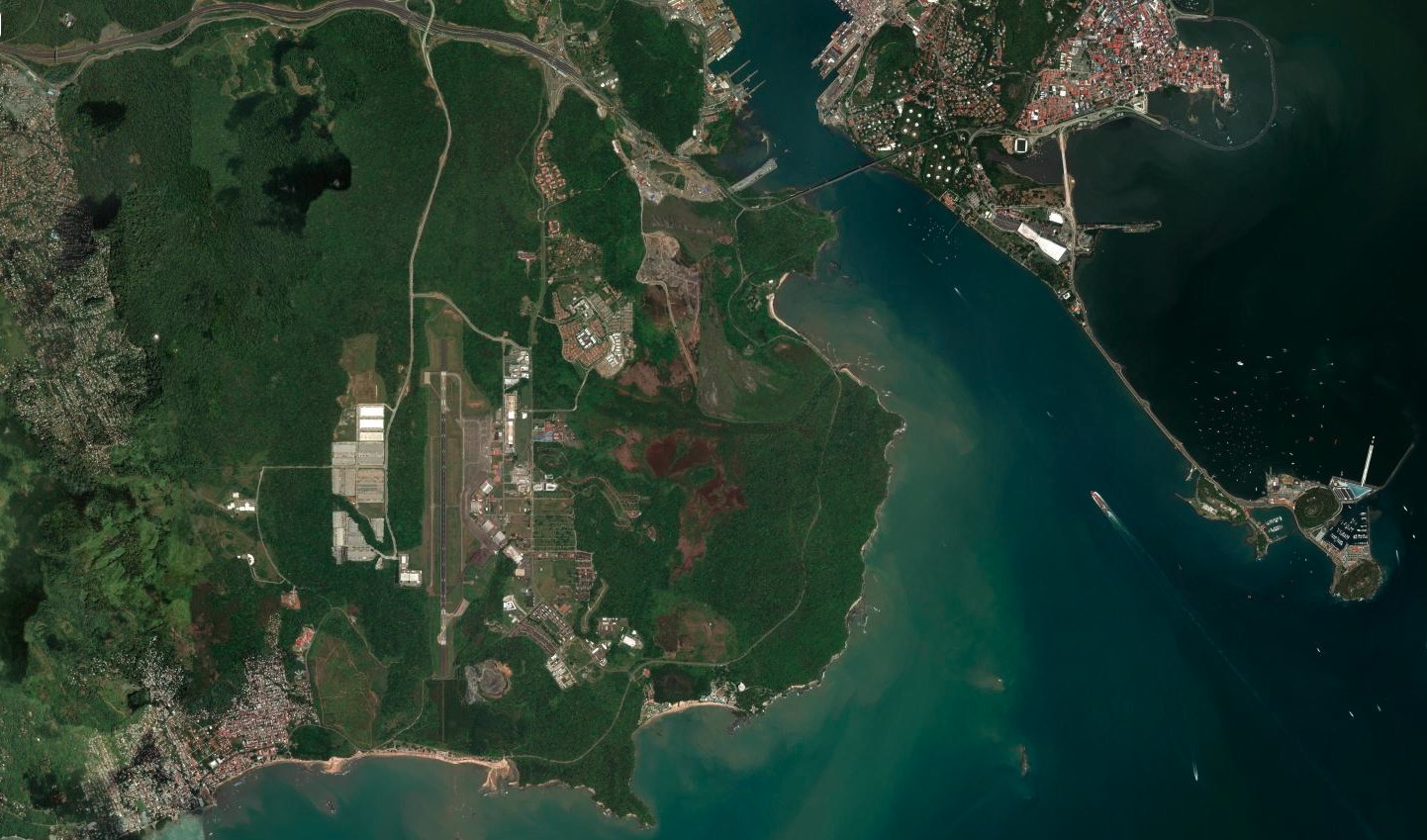
The Panama Canal has not closed in 110 years. But it has narrowed.
The standard scenario analysis for maritime chokepoints is binary: open or closed. For the Strait of Hormuz, that framing has held. The Panama Canal does not close. It throttles. Under drought conditions, the Autoridad del Canal de Panamá progressively restricts the number of daily transits and the maximum permitted vessel draft, reducing effective throughput over weeks and months rather than hours. The 2023–24 El Niño drought event did not produce a single catastrophic event. It produced a six-month, stepwise reduction in canal capacity from 36 transits per day in normal operations to 18 per day at the February 2024 nadir, a 50% throughput reduction sustained over a period long enough to restructure trade routing patterns across the Pacific Basin.
This distinction matters. A progressive throttle is harder to price than a binary closure. The onset is gradual, the severity uncertain, and the duration dependent on rainfall patterns that are themselves probabilistic. Second, a throttle does not affect all vessel classes or all commodity types equally. The distribution of impact across the vessel hierarchy is asymmetric in ways that have direct implications for the agricultural supply chains that depend on Handymax and Supramax bulk carriers, underrepresented in the energy-focused analysis that dominates current coverage.
This paper has three purposes. It quantifies the probable range of trade exposure under throttling scenarios calibrated to the 2023–24 event. It validates those outputs against documented actuals to assess model performance in a partial-severity condition. And it situates the analysis within a forward-looking risk framework that is not speculative: NOAA's Climate Prediction Center assigned a 61% probability to El Niño emergence by mid-2026 in its April 2026 update, with a further finding that by the November 2026 to January 2027 peak, the probability of a moderate-to-very-strong event reaches approximately 75% (ACP, 2026; NOAA CPC, 2026).
Reliance on Gatun Lake is the operational constraint binding everything downstream.
The Panama Canal's operational capacity is determined by the water level of Gatun Lake, the artificial reservoir that feeds both the Panamax locks and the larger Neopanamax locks opened in 2016. Gatun Lake is freshwater-fed: its level is maintained entirely by rainfall over the Panama watershed, averaging approximately 2,600mm per year. There is no significant alternative source and no pumping infrastructure of the scale required to compensate for a rainfall deficit. Each lockage displaces approximately 200 million litres of freshwater into the ocean. When the lake level drops, the ACP has a single lever: reduce lockage frequency and restrict the maximum draft of transiting vessels.
El Niño events produce a well-documented suppression of wet season rainfall over the Panama watershed. During the 2023–24 event, total calendar year 2023 rainfall was 30% below the long-run average. October 2023 recorded 41% below average, the lowest October precipitation since records began in 1950 (World Weather Attribution, 2024). The cumulative effect was a Gatun Lake level decline from its normal end-of-rainy-season high of approximately 88 feet above mean sea level to 79.6 feet at the August 2023 low, recovering partially but remaining below operational norms through Q1 2024. An independent attribution analysis found that the level of drought that produced the 2023 shipping disruption was "unlikely" without the concurrent El Niño forcing (World Weather Attribution, 2024).
The structural risk is not limited to the 2023–24 event. Muñoz, Lawrence, and Wang (2025), analysing Gatun Lake hydrology under CMIP6 climate projections, found that minimum annual lake levels decline substantially through the 21st century under moderately high and high emissions pathways (SSP3-7.0 and SSP5-8.5), driven primarily by reduced wet season precipitation. Under those scenarios, the frequency of droughts equivalent to the 2023–24 event approximately doubles by the end of the century. The implication is not that conditions will deteriorate linearly, but that the 2023–24 disruption should be understood as a recurring risk within a normal operational planning horizon, not a once-in-a-generation event.
The draft restriction is not symmetric. Neopanamax vessels lose 40% cargo capacity. Bulk carriers lose transit priority.
A Panama Canal throttle distributes costs unequally across the vessel hierarchy. The mechanism differs by vessel type, and the practical consequence is that the trade flows most affected are not those that dominate financial coverage.
The Neopanamax locks, opened in 2016, accommodate vessels up to 1,200 feet in length with drafts up to 50 feet. These locks handle the largest container ships transiting the canal. Under the 44-foot draft restriction imposed in 2023, a Neopanamax container vessel that would normally transit laden to approximately 12,500 TEU is limited to approximately 7,500 TEU: a 40% reduction in cargo capacity per transit (Port Economics, Management and Policy, 2024). This creates a direct and quantifiable capacity loss for container trade even with no reduction in transit frequency.
The original Panamax locks, handling vessels up to approximately 39.5-foot draft, are less directly affected by a 44-foot restriction because Panamax-class vessels already operate within that envelope under normal conditions. The primary impact on Panamax-class traffic is the reduction in daily transit slots, which affects all vessel types proportionally but is compounded by the priority slot auction system.
The priority slot auction mechanism is the critical distributional variable for agricultural commodity flows. When the ACP reduces available daily transit slots, it operates a tiered auction system in which operators can bid for priority passage. High-value container cargo, where the cost of a week's delay on time-sensitive manufactured goods is significant, consistently outbids lower-value bulk commodity cargo. The empirical result is that bulk carrier operators, who carry grain, coal, and fertiliser, are displaced from the transit queue at rates higher than the simple transit reduction percentage would imply. Fuentes and Munim (2025), analysing the relationship between ENSO indices and Panama Canal operational data, confirmed that El Niño events reduce bulk carrier transits proportionally more than container or other high-value segments, consistent with this auction mechanism.
When available transit slots fall below demand, the ACP runs a daily priority auction for one or more additional slots. Any vessel that has been waiting in the anchorage queue for at least ten days may participate, with an opening bid of $55,000. During normal operations, super booking fees run $135,000 to $140,000. During the 2023–24 drought, winning bids reached $3.975 million: the documented record, paid in November 2023 by Japan's Eneos Group for an LPG carrier named Sunny Bright.
The price escalation was not arbitrary. It was the market revealing each vessel class's walk-away price: the maximum a rational operator would pay for a canal slot before finding the long way around cheaper, east via Suez and the Red Sea rather than west around South America, a route that carries almost no commercial grain traffic at all. That walk-away price is a function of three variables: cargo value, scheduling constraint, and whether a Suez or Cape of Good Hope detour is physically or commercially feasible.
At the November 2023 peak, an LPG or LNG carrier had the same logic pushing it to bid rather than divert: Suez adds weeks, boil-off losses accumulate en route, and the cargo value justifies almost any slot price. For a Neopanamax container ship, the locks themselves are the constraint: the vessel's beam exceeds the original Panamax lock dimensions, so the Neopanamax locks are the only available passage regardless of price. All three classes bid to the top through the drought's acute phase. That did not hold for LNG once the Red Sea itself turned unsafe. Once Houthi attacks on Red Sea shipping escalated in December 2023, gas carriers judged the war risk unacceptable for their cargo even before charter economics forced the issue, and skipped Suez entirely: US LNG cargoes to Asia transiting Panama fell from 38 in the third quarter of 2023 to just 10 a year later, with roughly 94% of US LNG bound for Asia routing via the Cape of Good Hope by 2024, about 20 days longer than Panama and 10 longer than Suez. VLGCs carrying LPG stayed on the bid-and-pay path: neopanamax lock slots effectively reserved for them fell from 31 a day to 8 by early 2024, and one VLGC auction slot sold for a documented $2.85 million. For a Handymax bulk carrier with 50,000 tonnes of grain, the arithmetic is different, and the direction matters. The real alternative to Panama for US Gulf grain bound for Asia was never Cape Horn, a route modern cargo ships essentially do not use. It was Suez and the Red Sea, sailing the long way east rather than the short way west. The Suez detour adds approximately 18 days at sea, roughly $540,000 in additional charter time at a $30,000-a-day Handymax rate, well below the auction prices bulk operators were facing. That is precisely what happened: US Gulf grain shipments to East Asia that ran 80% via Panama in October 2022 had flipped to 91% via the Red Sea by late October 2023, and by late November, 15 of 16 tracked vessels were routing that way, essentially none through the canal. For the full route-by-route breakdown, including why that fleet had to move again a few weeks later, see The long way around.
The auction, in other words, is not merely a pricing mechanism. It is a sorting instrument. It systematically displaces low-value bulk cargo, grain, coal, and fertiliser, while preserving transit access for high-value cargo that can afford to bid. For an underwriter or a commodity desk, the relevant number is not the transit count reduction alone, but the price at which their cargo class exits the queue.
A further constraint applies to the largest dry bulk vessels. Capesize bulk carriers, with beam widths exceeding the Panamax lock constraint, cannot transit the Panama Canal under any conditions. Iron ore and coal flows on Capesize vessels, notably Australian coal to East Asia, are already routed via the Cape of Good Hope as standard operations. The Panama Canal throttle does not affect these flows at all. The commodity classes that depend on Handymax and Supramax bulk carriers for Pacific Basin routing, principally grain, bear the concentrated operational risk of both transit reduction and priority displacement.
The diversion did not stay pointed toward Suez for long. Once Houthi attacks on Red Sea shipping escalated in December 2023, that route stopped being safe either, and the same fleet had to move again: by late December, US Gulf to East Asia grain routing had shifted to approximately 69% via the Cape of Good Hope, 19% still risking the Red Sea, and 13% back on Panama. A fleet displaced from a short Pacific crossing by drought ended up circling the Atlantic twice in the opposite direction within about ten weeks, first east around Africa's northern route, then further east around its southern one, chasing whichever ocean was safest and cheapest at that moment.
Two changes since the May 2026 version of this article, both material to the tables below. First, corn (HS 1005) is now a real, independently-pulled UN Comtrade commodity in the model rather than a placeholder — wheat, soybean, and corn are tracked as three separate lines throughout, not merged into a single "grain" bucket, on the view that food-security analysis will eventually need to know which grain is exposed, not just that "grain" is.
Second, and more consequential: the routing engine that assigns bilateral trade flows to chokepoints was found to be taking only each country's dominant port basin and silently discarding the rest, even where a country had genuine port capacity on both the Atlantic and Pacific sides. US grain exports, for example, really do split roughly 83/17 between Gulf/Atlantic ports (Houston, New Orleans) and Pacific Northwest ports (Seattle) — but the routing engine was crediting Panama with 100% of that trade regardless, because Seattle's real Pacific-direct routing was never being consulted. The same issue affected import-side countries that lacked any grain port in the routing database at all: Japan, South Korea, Colombia, and Mexico among them, all now added. Fixing this drops this page's aggregate grain-trade-at-risk figure from the previously-published $31B–$93B range to $9.3B–$28.0B — a real correction, not a change in underlying risk, and one that removes some genuinely mistaken country-level claims (Mexico's corn exposure was never really 53%; Brazil's wheat exposure was never really 99.5%) while leaving Japan and South Korea's real, structural exposure intact or, in Japan's case, properly recognised for the first time.
Third, on 5 October 2026: a further routing correction (Fix-130) removed roughly $137 billion of Asia to Europe and Asia to West Africa trade that had been wrongly assigned to Panama. It does not change any grain figure on this page. It does remove the all-commodity aggregate that the monthly progression table used to show, which is why that column is gone.
The energy story dominates coverage. The agricultural story is where the binary constraints are.
Panama Canal analysis in commercial shipping focuses disproportionately on container trade. The agricultural commodity exposure is structurally different and, for a subset of importers, considerably more acute. The canal carries a significant fraction of US corn and soybean exports destined for Asia, Southern Cone grain flows, and wheat imports for several Latin American economies with limited overland alternatives.
| Importer | Dep. % | VaR at 100% | VaR at 50% sev. | Alternative path |
|---|---|---|---|---|
| China | 62.7% | $2.36B | $1.06B | Brazilian and Argentine origin viable substitute but faces same Canal constraint |
| Japan | 47.1% | $1.85B | $0.83B | Partial: PNW and Ukraine routes exist but are volume-constrained. See note. |
| South Korea | 39.8% | $1.16B | $0.52B | Partial: same constraints as Japan |
| Colombia | 64.5% | $1.02B | $0.46B | Atlantic side only for this trade: Panama routing required |
| Peru | 95.1% | $0.98B | $0.44B | No viable alternative at scale within a single season |
| El Salvador | 83.8% | $0.17B | $0.07B | No land alternative at comparable freight economics |
This table changed shape substantially in the August 2026 model update, and the change is itself the finding. The May 2026 version of this table led with Mexico at 53.2% Panama dependency ($5.76B) and included Vietnam (17.1%) and Taiwan (6.8%). All three have been removed. Mexico's US corn imports move by rail and short-sea Gulf routing that never approaches the isthmus — a routing-engine limitation was crediting Panama with Mexico's land-border trade, and correcting it takes Mexico's real Panama corn exposure to effectively zero, not a large partial number. Vietnam's corn (mostly South American and Black Sea origin) was already correctly reaching Vietnam via Malacca, Suez, and Bab el-Mandeb without ever touching Panama; the old table's Panama attribution for Vietnam did not hold up. Taiwan currently has no corn coverage in the model at all — a genuine data gap, not a verified zero, and it is dropped from this table rather than asserted either way. Japan and South Korea, the two importers the "why substitution is slower than it looks" callout below is built around, remain genuinely and materially exposed once the routing is corrected — that part of the original analysis holds.
| Importer | Dep. % | VaR at 100% | VaR at 50% sev. | Alternative path |
|---|---|---|---|---|
| China | 33.2% | $17.52B | $7.88B | Brazilian origin via Atlantic viable but ships through Canal or Cape Horn |
| Japan | 48.3% | $0.92B | $0.41B | No alternative soy source that bypasses Panama at scale |
| South Korea | 49.3% | $0.35B | $0.16B | Same constraint as Japan |
| Colombia | 64.2% | $0.14B | $0.06B | Partial: Pacific-side import infrastructure (Buenaventura) now reflected |
| Mexico | 3.0% | $0.05B | $0.02B | Mostly land-border/short-sea; residual is non-US-origin soy |
China's figure moved the most in absolute terms: $58.42B down to $17.52B. This is not a routing correction so much as a stale-data correction — the May 2026 article's underlying bilateral figure predates the CDM v3 multi-vintage rebuild (5 August 2026), which blends 2022 and 2024 UN Comtrade pulls and replaced a number that, on reflection, implied a larger share of China's total soybean import book than independent trade data supports. Thailand (32.9% in the earlier table) is gone for the same reason Vietnam is gone from the corn table: its soy imports route to Southeast Asia without a Panama transit. Japan's dependency moved the other way, from a implausibly low 3.0% up to 48.3%, once its Kashima grain-import terminal was added to the routing model and the US Gulf/Pacific Northwest export split (roughly 83/17) could actually be applied on the Japan side instead of collapsing to a single default. Colombia's number came down from a mechanically-forced 100.0% to 64.2% once Buenaventura, Colombia's real Pacific-coast grain gateway, was added — the remaining Atlantic-side share genuinely does need Panama.
The obvious question is why Japan and South Korea cannot simply source corn from US Pacific Northwest ports or alternative origins. The answer is structural, not theoretical. (Vietnam and Mexico no longer belong in this question — the corrected routing shows both already sourcing corn in ways that don't touch Panama at meaningful scale, which is precisely why they've dropped out of the table above.)
US Pacific Northwest corn: The Columbia River grain terminals, primarily Portland and Longview, do export corn directly to Asian buyers. This route requires no Panama transit. But PNW corn export capacity is a fraction of Gulf capacity, constrained by rail throughput from the Midwest and fixed terminal infrastructure. Japan imports approximately 15–16 million tonnes of corn per year. PNW corn export volumes cannot compensate for Gulf displacement within a single season, and terminal capacity cannot be rapidly scaled.
Brazilian and Argentine corn: Both countries are now among the world's largest corn exporters, but they ship from Atlantic ports, principally Santos and Rosario. A vessel carrying Brazilian corn to Japan must either transit the Panama Canal (also affected under this scenario) or reroute via Cape Horn, adding 38 days and approximately $1.14M in voyage cost per Handymax. (The Horn is the reference case for this cost, not what vessels did in practice: the sister analysis sets out why almost no one sails it and what they do instead.) Substituting South American origin does not eliminate the Panama constraint for Asian buyers. It replaces one exposure with another.
Ukrainian and Black Sea corn: Ukraine ships from Black Sea ports through the Bosphorus and Suez Canal to Asia. This route does not touch Panama and represents a genuine sourcing alternative that bypasses the Canal constraint entirely. Japan and South Korea do import Ukrainian corn. The limitation is war-related supply uncertainty and elevated Black Sea insurance costs, which constrain available volumes and add their own freight premium.
Africa: Sub-Saharan Africa is a net corn importer across most of the continent. South Africa exports 2–3 million tonnes per year in a good season, relevant for regional food security but not at the scale required to substitute for Japan or Korea's annual import volumes.
The practical constraint: Sourcing substitution is possible over two to three seasons, given time to renegotiate purchase contracts, secure vessel capacity, and adjust storage logistics. Within a single six-month disruption event, the combination of volume constraints (PNW), concurrent Canal exposure (South America), war risk (Ukraine), and contract rigidity means that most exposed buyers face higher costs, not alternative supply. The model VaR figures reflect this short-run constraint.
The wheat picture adds a further dimension, and it is where the basin/elasticity correction matters most directly. The May 2026 version of this paragraph put Ecuador at 100% canal dependency, Colombia at 98.2%, and Brazil at 99.5%. Brazil should never have been in that list at all: Brazil is an Atlantic-facing wheat importer for US-origin supply and does not route through Panama for it, and Brazil does not appear in the corrected Panama wheat table at all now — its absence is the correct answer, not a gap. Ecuador (68.9%, $0.35B) and Colombia (53.8%, $0.31B) remain genuinely exposed but well below the earlier near-total figures, for the same reason as the corn and soybean corrections above: both had real, mechanically-forced 100%-style attribution before either country had a Pacific-side import port in the routing model. Peru (60.3%), Chile (65.6%), Japan (51.8%), and South Korea (34.4%) are the other importers with material modeled wheat exposure through Panama; Japan in particular moved up from an unmodeled near-zero to a genuine structural figure once its own import-side routing was corrected, mirroring the soybean story.
The model run at three severity levels, calibrated to the 2023–24 event.
The Narrows Chokepoint Dependency Model is designed for binary closure scenarios at adjustable severity and duration. For Panama Canal analysis, a partial-severity run more accurately reflects the nature of the disruption mechanism: the model is applied at 33%, 50%, and 100% severity, corresponding respectively to the November 2023 throughput (24 transits per day), the February 2024 peak (18 transits per day), and the analytical full-closure ceiling.
The model applies a Panama-specific sensitivity factor of 0.90 to reflect the partial substitutability of canal routing via alternative vessel paths. Value at risk is calculated as exposed trade value multiplied by severity multiplied by the sensitivity factor. Rerouting penalty is calculated on a Handymax bulk carrier basis, the relevant vessel class for agricultural commodity flows, at $30,000 per day all-in (bunker plus charter) over 38 days to Cape Horn, producing a per-voyage overrun of $1.14 million. This figure should be treated as a floor rather than a ceiling: current BCI Capesize spot rates in May 2026 of approximately $35,000 per day suggest real-world rerouting costs are materially higher than the 2023 model baseline.
| Scenario | Transit rate | Throughput reduction | Grain VaR | Reroute / voyage | Historical analogue |
|---|---|---|---|---|---|
| Low | 24/day | 33.3% | $9.3B | $1.14M | Nov 2023: initial ACP intervention (proportional-severity floor; observed bulk displacement ran higher) |
| Mid | 18/day | 50.0% | $14.0B | $1.14M | Feb 2024: peak drought severity |
| High (ceiling) | 0/day | 100% | $28.0B | $1.14M | Analytical ceiling: no historical precedent |
A further finding from the model run deserves separate attention. The monthly progression of the 2023–24 event, applied to the Narrows model, shows that the Neopanamax draft restriction imposed in May 2023, before the ACP reduced a single transit slot, produced a 16% container-side severity purely from the 40% per-transit cargo capacity loss (the dollar figure published for this in earlier versions of this page has been withdrawn; see the correction note at the foot of the page). A vessel operator does not require a transit reduction to absorb a material cost: the draft restriction alone, if sustained over a full quarter, generates a significant volume impact on container trade flows even with the same number of transits running. This is the vessel-class differentiation story in a quantified form that is absent from most Canal coverage.
| Month | Transits/day | Bulk severity | Container severity |
|---|---|---|---|
| May 2023 | 36 | 0.0% | 16.0% |
| Jul 2023 | 32 | 11.1% | 25.3% |
| Sep 2023 | 28 | 22.2% | 34.7% |
| Nov 2023 | 24 | 33.3% | 44.0% |
| Jan 2024 | 22 | 38.9% | 48.7% |
| Feb 2024 | 18 | 50.0% | 58.0% |
Model outputs at 50% severity against documented 2023–24 actuals.
The 2023–24 El Niño drought provides a rare opportunity to test a throttling model against observed outcomes. The model was not calibrated to the 2023–24 event: it is run post-hoc at the severity parameters that match the documented ACP operational record, and the outputs are compared against reported market outcomes.
Grain routing diversion. In the four-week period ending 31 October 2023, US Gulf grain vessels transiting the Panama Canal declined from 34 to 5, an 85% reduction in bulk grain transit volumes at a point when the ACP had reduced daily transits by approximately 33% from baseline (Rabobank, 2023). The model at 33% severity (Low scenario) produces a bulk displacement of 33% through the transit reduction mechanism alone. The observed 85% diversion rate implies a substantially higher effective displacement of bulk cargo than the transit count reduction alone would produce. This is consistent with the priority auction mechanism described by Fuentes and Munim (2025): the residual transit capacity at 24 per day was preferentially allocated to higher-value container cargo, displacing bulk at rates exceeding the proportional throughput reduction. The model identifies the direction of this displacement but understates its size: observed bulk displacement ran well above the proportional severity the model applies, and the model does not explicitly model the auction mechanism. The Low scenario below should therefore be read as a proportional-severity floor for grain trade at risk, not a calibrated estimate of what November 2023 actually displaced.
Freight rate pressure. Average container freight rates rose from approximately $700 per TEU in November 2023 to approximately $1,900 per TEU in January 2024 (S&P Global, 2024). The Handymax Cape Horn rerouting penalty of $1.14 million per voyage, 38 days at $30,000 per day, is a reference-case cost for canal-dependent bulk operators displaced from the canal. Most did not sail the Horn; the Suez route (+18 days) was what grain vessels actually used, per the sister analysis, so treat $1.14M as the upper end of the displacement cost, not the typical one. The observed freight rate increase is directionally consistent with this cost pressure. The model does not forecast freight rates; it provides the cost input from which rate pressure is derivable.
Aggregate exposure magnitude. The ACP reported that the 2023–24 drought produced its most severe operational disruption in the canal's 110-year history (ACP, 2024). Independent analyses estimated total economic impact to global trade in the range of tens of billions of dollars across the disruption period. This page no longer publishes an all-commodity aggregate VaR for the event: the figures it carried before were built on a routing base that wrongly sent roughly $137 billion of Asia to Europe and Asia to West Africa trade through the canal, and a replacement needs a documented bulk and container methodology that has not yet been built. The grain-specific figures are the current ones, and the severity columns in the table above are model inputs, not outputs.
The canal is fully operational today. NOAA gives a 75% probability of a moderate-to-very-strong El Niño by peak season. History puts the impact window in 2027.
The canal recovered through 2025 as a La Niña pattern restored above-average wet season rainfall. By early 2026, the ACP had rebuilt Gatun Lake reserves to historically high values and was operating at near-normal throughput of approximately 36 daily transits. From a market perspective, the 2023–24 event appeared to have passed.
NOAA's Climate Prediction Center April 2026 update presents a different picture for the coming 12 months. ENSO-neutral conditions are currently in place, with La Niña ending. El Niño is assessed as likely to emerge in the June to August 2026 window, with a 61% probability of emergence by mid-year and persistence through at least end-2026. The more operationally significant figure is in the strength distribution: for the November 2026 to January 2027 peak season, the CPC assigns approximately equal 25% probability to very strong, strong, and moderate El Niño events, with roughly 10% probability of neutral conditions. That puts the combined probability of at least a moderate event at approximately 75% at peak season (NOAA CPC, 2026).
This matters for Panama Canal operational planning because the most pronounced effects on canal throughput have consistently materialised in the year following El Niño onset. The 1982–83, 1997–98, 2015–16, and 2023–24 events all show the same pattern: an El Niño develops mid-year, the wet season delivers below-average rainfall, and by the following dry season Gatun Lake levels are sufficiently reduced to trigger draft restrictions and transit cuts. Applied to a 2026 El Niño onset, the operational impact window falls in 2027, consistent with the ACP's own forward guidance (ACP, 2026; Riviera Maritime Media, 2026).
That pattern held across four prior events. It has not held for this one. The ACP's own draft and transit restrictions arrived within the onset year itself, in August and September 2026, not in the following dry season as the historical pattern and the ACP's own April 2026 guidance implied. Whether this reflects a shorter lag at this specific lake-level starting point, a more aggressive ACP posture after 2023-24, or simply a faster-developing event is not yet possible to say from one data point, but the 2027 window above should not be read as the earliest date operational impact can occur. See the live update at the top of this page.
The structural trajectory compounds this. Muñoz et al. (2025) project that under moderately high emissions pathways (SSP3-7.0), the frequency of low-water events equivalent to the 2023–24 drought doubles by the end of the century. The water-saving measures the ACP introduced in late 2025, including cross-filling procedures, suspension of hydroelectric generation during low-water periods, and increased use of water-saving basins in the Neopanamax locks, extend the operational buffer but do not address the underlying hydrological constraint.
The numbers are in the model. The pricing is not in the market. Here is what each desk should be doing with the gap.
The 2023–24 event established that a Panama Canal throttle produces quantifiable, bilateral, commodity-specific financial exposure. The Narrows model provides those numbers. The observation that is more useful to a risk professional than any single VaR figure is that this exposure is, in most cases, not currently priced or hedged in the counterparties that carry it. The following is how the analysis translates into action across the desks that are most directly affected.
Underwriters and P&I clubs. Traditional cargo policies do not cover throttle-related losses. There is no physical damage trigger. What accumulates instead is indirect exposure: delay claims, spoilage on extended Cape Horn voyages for temperature-sensitive cargo, general average contributions where rerouted vessels encounter further incidents, and reinsurance accumulation across books with correlated Canal exposure. The critical analytical gap for underwriters is accumulation modelling. A cargo book that is diversified by geography can still be substantially concentrated in Panama-dependent routing if a significant portion of its Handymax and Supramax bulk exposures move on the US Gulf to Asia corridor. The Narrows model provides the bilateral dependency matrix to identify that concentration. The natural product that closes this gap is a parametric structure linked to ACP transit counts: a trigger at fewer than 24 transits per day sustained for 30 consecutive days, with a payout schedule calibrated against the corridor dependency matrix. The model provides the exposure layer; the trigger is already observable and publicly reported.
Commodity trading desks. The immediate price signal in a throttle event is basis widening: the freight differential between US Gulf delivery and Pacific Asian destination blows out as displaced vessels seek the Cape Horn alternative. At $1.14 million additional voyage cost on a Handymax carrying approximately 50,000 tonnes of corn, that is $22.80 per tonne in additional freight, roughly 11% of the delivered corn price at current levels. Trading houses with contractual optionality on origin, the ability to shift purchasing toward US Pacific Northwest, Ukrainian, or Australian origins, capture the basis differential as margin. Those without that optionality pass the cost to buyers or take it as a loss on open positions. The model identifies which bilateral trade flows are most exposed and by what magnitude, giving a cargo desk the information needed to restructure origin mix before a disruption rather than during it.
Commodity derivatives and freight markets. A Panama throttle is structurally bullish CBOT corn: reduced export capacity tightens US domestic stocks while simultaneously reducing supply to the most import-dependent Asian buyers. The basis trade is straightforward in principle, long CBOT corn versus short Pacific freight, but the freight derivatives market for Panamax and Handymax routes is thin and illiquid compared to the Capesize market. The model does not generate a derivatives position directly, but it produces the position size, the bilateral exposure in dollars by commodity, that a trader would need to justify a futures or options structure. The gap between the model's $14.0B mid-severity grain VaR and the typical open interest in grain freight derivatives indicates the extent to which this risk is unhedged at an industry level.
Food security and policy. The financial desks absorb cost through freight premiums and basis adjustments. The food security question is different: who cannot absorb the cost at all. Japan and South Korea have the foreign exchange reserves and import flexibility to pay higher delivered grain prices for a season without a domestic supply crisis. Vietnam, Colombia, and Ecuador operate at tighter margins. A sustained six-month throttle that adds $22 to $30 per tonne to delivered corn and wheat costs passes through to domestic feed prices, then to livestock production costs, then to retail food prices, in economies where food expenditure is a higher share of household income. The 2023–24 event contributed to elevated agricultural commodity prices across Canal-dependent economies in Q4 2023 and Q1 2024. A repeat event with a moderate-to-strong El Niño driver would produce the same transmission. The policy question, for institutions such as ERIA, ADB, and the ASEAN Secretariat, is whether regional food security frameworks account for a recurring, hydrologically-driven supply chain shock that bilateral trade dependency analysis can now quantify in advance.
The probable range is $9.3B to $28.0B in grain trade at risk. The mid-point is $14.0B. Neither figure is in most risk models.
The Narrows Chokepoint Dependency Model produces three outputs for Panama Canal throttling scenarios: value at risk, rerouting penalty, and the commodity and country breakdown of exposure. The grain trade at risk range, $9.3B at 33% severity, $14.0B at 50% severity, and $28.0B at full closure, is derived from a multi-vintage blend of 2022 and 2024 UN Comtrade bilateral data (CDM v3, rebuilt August 2026) applied to a basin-aware corridor dependency matrix for corn, soybean, and wheat, tracked as three separate commodity lines rather than a merged grain bucket. Wheat and corn are Tier 3 (Estimated); soybean is Tier 2 (Corroborated, ~50% bilateral-match coverage). This range is roughly a third of the $31B–$93B figures published in the May 2026 version of this article — the reduction is a routing and data-vintage correction, documented below, not a change in the underlying risk.
The figures that are most analytically stable are those for the East Asian importers: Japan corn and soybean exposure at the mid-point severity runs to approximately $1.2B combined; South Korea approximately $0.7B. These are not the largest absolute numbers in the matrix. China's soybean exposure at 50% severity is $7.9B. But Japan and South Korea carry a structural constraint that China does not: no viable domestic production substitute at scale, and Pacific routing that is physically dependent on canal access or Cape Horn. For an underwriter assessing accumulation risk or a project finance team stress-testing a food import facility, those are the figures that belong in a scenario model.
The throttle problem, in the end, is a pricing problem. A full closure is dramatic, discussable, and precisely because it is dramatic, already present in most scenario frameworks. A sustained six-month reduction to 50% throughput is less dramatic, harder to communicate, and almost entirely absent from the risk models of the counterparties most exposed to it. The 2023–24 event established an empirical baseline. The forward ENSO outlook indicates the relevant risk horizon. The bilateral dependency data identifies who is on the hook. Running those inputs through a parametric model before the disruption begins is the step that most desks have not taken.
Correction, 5 October 2026. The all-commodity aggregate VaR column and the aggregate validation figures that this page used to carry have been withdrawn. A routing audit (Fix-130) found that the basin rules treated every Atlantic-basin port as American, so Asia to Europe container, vehicle and electronics trade (for example China to Germany HS 8471, Japan to Belgium HS 8703) and Asia to West Africa trade were assigned a Panama leg. After the fix, those flows route via Malacca, Bab el-Mandeb, Suez and Gibraltar (Europe) or around the Cape (West Africa), and Panama-routed trade in the model falls from roughly $348 billion to roughly $210 billion, every flow of which now has an American endpoint. The grain-specific figures throughout this page (stat bar, corn/soybean/wheat tables, Low/Mid/High grain VaR scenario table) are unaffected: no grain flow had a European or African Atlantic endpoint on a Panama route. A re-derived all-commodity progression will be published only with its methodology.
References
ACP (2026). The Panama Canal responds to the risk of El Niño with foresight. Autoridad del Canal de Panamá.
BTS (2024). Vessel Draft Restrictions on the Panama Canal by Locks: February 2022–August 2024. Bureau of Transportation Statistics.
Fuentes, G. and Munim, Z.H. (2025). Climate influence on Panama Canal operations: predicting canal water times with integrated environmental and operational data. Transportation Research Part E, 203. DOI: 10.1016/j.tre.2025.103606.
Muñoz, S., Lawrence, Z. and Wang, S. (2025). Drying of the Panama Canal in a warming climate. Geophysical Research Letters, 52(18), e2025GL117038. DOI: 10.1029/2025GL117038.
NOAA CPC (2026). ENSO: Recent Evolution, Current Status and Predictions. Climate Prediction Center / NCEP, 13 April 2026.
Port Economics, Management and Policy (2024). Effect of the Panama Canal draft limitation on containership capacity. porteconomicsmanagement.org.
Rabobank (2023). The Panama Canal needs a rainy October: impacts of Panama Canal drought on global agricultural trade.
Riviera Maritime Media (2026). Panama Canal Authority warns of potential El Niño impacts in 2027.
S&P Global (2024). Panama Canal draft restrictions offer sustained challenge for carriers.
World Weather Attribution (2024). Low water levels in Panama Canal due to increasing demand exacerbated by El Niño event.
All model assumptions are substitutable. Contact fysh@narrows.io to run a scenario against your specific inputs.